Stone walls in western Liguria
April 10, 2020
A park at the forefront of climate change mitigation
April 17, 2020
by Ludovica Schiaroli
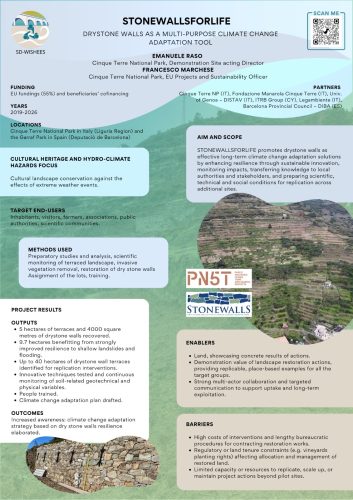
The Stonewallsforlife project replicates on a larger scale what the Manarola Foundation has achieved so far. An interview with Vice President Eugenio Bordoni.
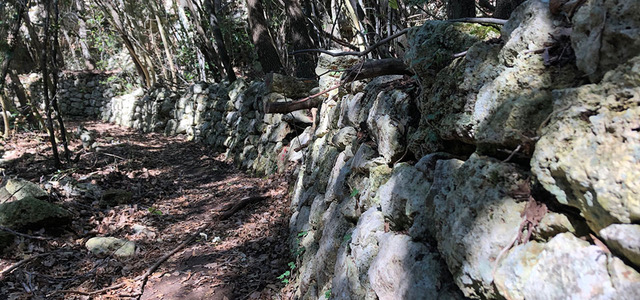
“I live at the top of the village of Manarola, and every day I wake up, look out of the window, and see these dry stone walls in a state of abandonment. I think it is a lack of respect for those who worked this land—my father, my grandfather, and all those who built these monuments of stone.”
These are the words of Eugenio Bordoni, Vice President of the Manarola Cinque Terre Foundation, one of the first to believe in the Stonewallsforlife project and in the importance of restoring dry stone walls to counter hydrogeological instability and climate change.
The Manarola Foundation was in fact created with this very mission, following the flood of October 25, 2011: “After those tragic days—13 deaths between the coast and inland areas, with the villages of Monterosso and Vernazza almost destroyed—local people wanted to equip themselves with an effective tool to protect the territory and their own safety,” explains Bordoni.
This marked the beginning of a path that led to the formal establishment of the Foundation in 2014, and the following year to the first restoration and cleaning works on the two hills surrounding Manarola, covering a total of 11 hectares.
“It is a participatory foundation,” Bordoni explains, “non-profit and exclusively dedicated to social solidarity in the field of environmental protection and enhancement.”
Why a Foundation is needed
“I always say we would need 10, 100, 1,000 Foundations—not only in Liguria, but in all those areas where the abandonment of rural land and depopulation put both the territory and its inhabitants at risk,” says Bordoni.
The Foundation acts as a bridge between private landowners and public institutions, in this case working with the National Park and the municipalities of the Cinque Terre.
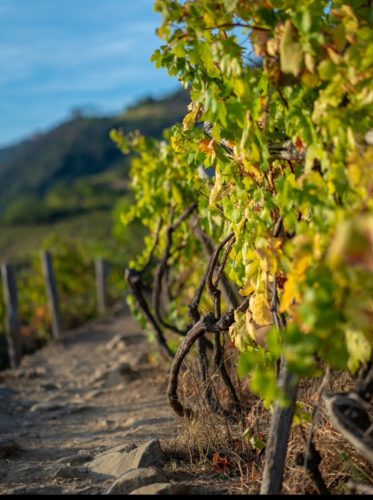
In simple terms, it performs an intermediation role: the Foundation leases abandoned or uncultivated land from owners and, after clearing it and restoring dry stone walls and drainage systems, rents it out (long-term) at the same price to agricultural businesses—preferably local ones—that ensure its maintenance.
“Land abandonment is the first issue to address,” Bordoni explains. “These are all small, family-run plots, abandoned after World War II by those who left in search of less demanding and more profitable work.”
The first challenge was mapping uncultivated land and identifying owners in order to begin restoration work.
“When assigning plots, we first consider contiguity, so that parcels can be grouped as much as possible,” Bordoni continues. “We also prefer to assign them to local agricultural businesses, so they can improve economies of scale. Of course, external operators are also welcome to apply.”
This is what has been done so far: the Stonewallsforlife project builds on this successful experience, with the aim of expanding and replicating it in other areas.
The Park as a driver of change
“If today we are here managing a European project, it is thanks to the Cinque Terre National Park, which believed in it from the beginning and contributed to its development, as well as to Ugo Miretti of ITRB Group and his love for this land,” Bordoni explains.
The goal, by the end of the project, is to restore almost all of the six hectares of land behind Manarola and then replicate the experience—most likely in Monterosso, Vernazza, and the Parc del Garraf in the Province of Barcelona.
Alongside the Park, which coordinates the project, are Legambiente, for its expertise in environmental science; the University of Genoa’s Department of Earth Sciences, for scientific monitoring; and the Diputació de Barcelona, which plays a key role in replicating the project in other European areas with similar conditions.
Passing on knowledge through solidarity
“Master builders capable of teaching how to construct dry stone walls can be counted on one hand,” Bordoni admits. “There is a real risk that this ancient knowledge could be lost.”
Yet restoring abandoned land could represent a major opportunity for the territory: currently, around 25 companies produce and sell wine locally and internationally, and there is strong potential for growth.
Part of the project directly addresses this need, through the launch of training courses for unemployed people and disadvantaged groups, ensuring that this knowledge is preserved and passed on.
In this way, the project tackles depopulation and labor shortages while creating new opportunities for employment and territorial development.
A special form of happiness
“In the end, what we are doing is preserving the landscape to make it even more beautiful,” Bordoni concludes. “I have a photo where the patterns of terraces and drainage channels are still clearly visible—it looks like a century ago, but it was taken in 1981.”
“For me, this project is a kind of collective work, almost like a time machine. Seeing these hills as my father saw them will be a special form of happiness.”