
The therapeutic value of a Park
August 17, 2020
Stonewallsforlife one year later
December 7, 2020
by Ludovica Schiaroli
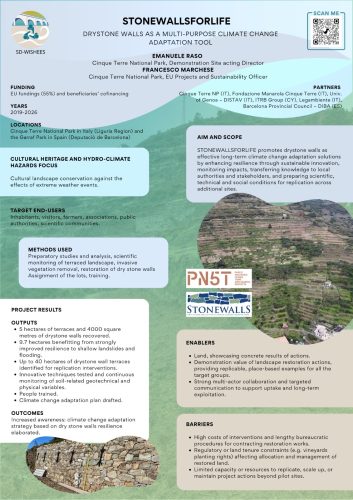
There is strong interest—particularly in the replicability of the project—in the words of Fabrizia Pecunia, Francesco Villa, and Emanuele Moggia, mayors of Riomaggiore, Vernazza, and Monterosso, regarding the European project Stonewallsforlife. Launched ten months ago in the Manarola amphitheatre (Riomaggiore), the project aims to restore approximately six hectares of dry stone walls.
The future lies with young farmers
Francesco Villa strongly believes this when he describes the growing “return to the land” taking place in the area and how the project aligns with restoring the importance of territorial care.
“In recent times, many young people have taken land under loan agreements. Instead of focusing only on traditional production such as wine and olive oil, they are cultivating citrus fruits, spices, and crops that were once traditional but had been partly forgotten. This represents a positive cultural shift,” says the Mayor of Vernazza.
He also highlights the uniqueness of the territory, where grapes, spices, and citrus fruits develop aromas found nowhere else.
“Cultivated land also guarantees greater well-being and safety for residents,” Villa adds. “And tourists can only appreciate a landscape that is maintained and cared for.”
A project that recognizes the value of the territory
“The project has great value for our territory because it represents how we want to build our future,” says Fabrizia Pecunia, Mayor of Riomaggiore.
Her words reflect both enthusiasm and pride in representing the area where the project is being tested.
“It can become a model, especially in terms of training. Today, we need to train people who will continue the construction of dry stone walls and the recovery of the territory in the future.”
Like the Mayor of Vernazza, Pecunia stresses that tourism alone is not enough, and that a balance with traditional activities must be restored.
“This project also reflects our history: the Cinque Terre was born by the sea, but its population has always been primarily connected to the land.”
She recalls the writings of Telemaco Signorini, who noted that in the 1940s, out of 3,500 inhabitants of Riomaggiore, only three families were fishermen, while the rest were farmers.
Even today, perhaps also due to the limited fish resources of the nearby sea, the bond with the land remains strong.
Replicability as a legacy
Emanuele Moggia, Mayor of Monterosso, also expresses strong interest in the project. Like Villa, he hopes for the success of the first “pilot” phase in Manarola so that Monterosso can later host a new edition of the initiative.
“What has been done is never enough,” explains Moggia. “The condition of dry stone walls in our municipality varies: many are being restored thanks to support from the Cinque Terre National Park, many are still abandoned, and others have been overtaken by vegetation. However, we are gradually seeing an increase in maintenance and restoration work.”
“All of this is important not only to recover agricultural land but also to ensure the safety of our territory.”
“But the project also represents recognition and an opportunity for our territory,” adds Fabrizia Pecunia. “That is why I truly hope it can become a replicable model in other municipalities, because restoring terraces and dry stone walls—especially in light of ongoing climate change—must be a priority.”
Project framework
Stonewallsforlife has a planned duration of five years (2019–2024). The total budget amounts to €3,715,000, of which the LIFE Programme will cover 55% of the costs, with an EU contribution of approximately €2,039,000.
The remaining funding is provided by the project partners: the Cinque Terre National Park (lead partner), the University of Genoa, ITRB Group, Legambiente, and Diputació de Barcelona as the international partner.