
Stonewallsforlife, an opportunity for the Cinque Terre
October 22, 2020
Collaborations across Europe for the dry stone walls of the Cinque Terre
December 15, 2020
by Ludovica Schiaroli
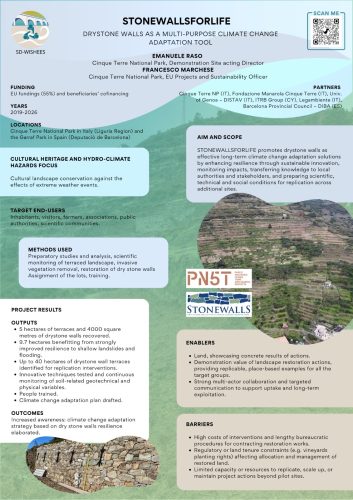
Just over a year after the launch of the Stonewallsforlife project in the Cinque Terre National Park, Emanuele Raso—geologist and project coordinator—describes the progress of the work and explains how such a complex initiative can continue despite the ongoing health emergency. The project involves not only extensive on-site activities but also coordination with national and international stakeholders.
“At the moment, we are carrying out the procedures for assigning services related to design and works supervision,” explains Raso. “This is a fundamental step for a public authority, following the preliminary studies conducted by the University of Genoa and the analysis and digitization of cadastral parcels carried out by the Fondazione Manarola and the Cinque Terre National Park.”
The current state of dry stone walls
Dry stone walls cover approximately 40% of the Park’s territory. In recent years, several areas have been subject to restoration projects led by agricultural businesses and private landowners, reversing a long-standing trend of abandonment.
The Park continues to promote initiatives aimed at restoring uncultivated land and maintaining active agricultural areas.
Responses from other territories
Stakeholders involved so far have shown great interest in the project, particularly international associations working to preserve terraced landscapes and dry stone wall techniques.
This collaboration further reinforces UNESCO’s recognition of dry stone wall construction as Intangible Cultural Heritage of Humanity.
Project partners and roles
The main partner is the Fondazione Manarola, which developed the model at the core of the project: identifying abandoned land, establishing loan agreements, and assigning it to agricultural businesses for restoration and productive use.
Other partners play equally essential roles:
-
ITRB: project management and relations with the European Commission
-
DISTAV (University of Genoa): scientific research
-
Legambiente: communication and administrative-financial management
-
Diputació de Barcelona: replication of the model in other EU contexts
Scientific activities
DISTAV has conducted detailed geological and geomorphological studies, reconstructing both the geological framework and the anthropogenic morphology of the area with a high level of detail.
This includes mapping drainage systems, digitizing dry stone walls, and creating a digital terrain model.
In the coming years, monitoring systems will be implemented to analyze slope erosion and the structural performance of walls built using different techniques.
Community perception
The local community is highly engaged and has high expectations for the project.
“At this stage, patience and trust are essential,” says Raso, “given the complexity of the project and the regulatory requirements involved.”
In the medium to long term, this model could represent a turning point for the recovery of abandoned land in a territory characterized by highly fragmented rural ownership.
Climate change: adaptation vs mitigation
“This project focuses more on adaptation than mitigation,” Raso explains.
Mitigation addresses the root causes of climate change (such as reducing greenhouse gas emissions), while adaptation aims to reduce its impacts by acting on the territory.
A practical example is the adaptation of riverbeds, which are no longer able to manage water flows caused by increasingly intense rainfall events.
Managing a project during a pandemic
Continuing such a complex project during a global pandemic has been extremely challenging.
“Beyond technical and operational delays, the human and social aspects—stakeholder engagement, meetings, field inspections—have shifted to a digital dimension, which tends to flatten the emotional component that drives these initiatives.”
The role of Fondazione Manarola
Fondazione Manarola played a key role in developing the project model and continues to contribute through:
-
training activities
-
identification of intervention areas
-
dissemination of results to local communities
Solidarity and social inclusion
Solidarity is deeply rooted in the cultural identity of the Cinque Terre.
This is reflected in initiatives aimed at integrating disadvantaged groups into the agricultural sector, including terrace restoration activities.
There is hope that, especially after the pandemic, social inclusion will further increase through projects like this and through responsible local entrepreneurship.
A personal choice
Raso, originally from Monterosso, chose to remain in his homeland despite having studied and worked abroad.
“They say ‘nemo propheta in patria’, but I would like to go against the grain,” he says. “Contributing to projects in the places where you were born and raised has immeasurable value. To do this, it is essential to know the territory and its traditions, while also having a broad outlook and solid education.”
“To put it simply: speaking both dialect and English.”