
Stonewallsforlife one year later
December 7, 2020
In Catalonia to discover the other site of the Stonewallsforlife project
January 12, 2021
by Ludovica Schiaroli
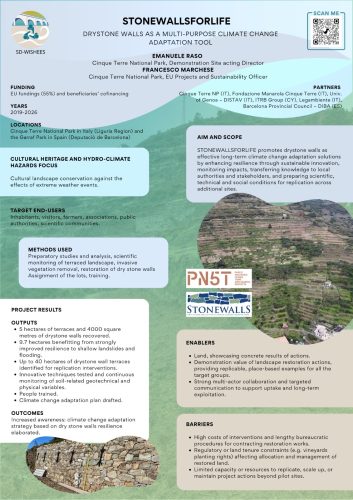
The charm of the Cinque Terre extends beyond national borders, capturing the attention of major European countries through a project that places its iconic dry stone walls at the center of a key action for climate change adaptation.
Just over a year after its launch, the LIFE project “STONEWALLSFORLIFE” has established significant collaborations with associations, public institutions, and private stakeholders, both in Italy and across Europe. Among them are several countries whose dry stone wall traditions, together with Italy, have been recognized by UNESCO as Intangible Cultural Heritage: Cyprus, Croatia, France, Greece, Slovenia, Spain, and Switzerland.
Among the main stakeholders who have responded positively to the invitation of Patrizio Scarpellini, Director of the Cinque Terre National Park and lead partner of the project, are the Swiss Association of Dry Stone Wall Builders, the Fédération Française des Professionnels de la Pierre Sèche, the Institute for the Protection of Cultural Heritage of Slovenia, the Service for Movable, Ethnographic and Intangible Cultural Heritage of the Croatian Ministry of Culture, the Petra stin Petra Foundation (Cyprus), the Department of History and Archaeology of the University of Cyprus, the Dry Stone Unit and Hiking Service in Palma de Mallorca (Balearic Islands), and in Catalonia, the Parc del Garraf.
Also included are UNESCO World Heritage sites such as the Upper Middle Rhine Valley in Germany—a 65-kilometer stretch of terraced slopes along the Rhine River between Koblenz and Bingen—and the Lavaux vineyard terraces in Switzerland, an area of 830 hectares between Lausanne and Montreux on Lake Geneva.
These are fragile and valuable landscapes, where dry stone walls define the territory, making it unique—just as in the Cinque Terre National Park, where the Stonewallsforlife project has been underway for over a year.
Scarpellini explains that associations and stakeholders will be involved on four levels:
-
Information: regular updates on progress and results
-
Consultation: gathering opinions and suggestions on risks and best practices
-
Co-design: participation in defining specific activities
-
Co-management: direct involvement in project implementation, particularly in adopting a climate adaptation plan
“We are very satisfied with this first result, which shows that stakeholders involved so far are highly interested in the project,” says Scarpellini. “This is especially true for international associations working to preserve dry stone wall techniques and terraced landscapes across Europe and beyond. This collaboration further reinforces UNESCO’s recognition of dry stone walling as a heritage of humanity.”
From a scientific perspective, important collaborations have also been established with the Euro-Mediterranean Center on Climate Change (CMCC), the International Terraced Landscapes Alliance (ITLA), and the Universities of Pavia and Naples.
Each partner, with its specific expertise, will support the University of Genoa’s Department of Earth Sciences (DISTAV) in developing monitoring systems for slope erosion and for evaluating the structural performance of dry stone walls built using different techniques.
“Despite the ongoing health emergency, work is progressing,” Scarpellini explains. “The initial field investigation phase carried out by the University of Genoa has been completed, and the Park, together with the Fondazione Manarola, has digitized the cadastral parcels. The procedures for assigning design and works supervision services for the terraces are now underway. As soon as it is possible to resume in-person activities, the first training courses will begin.”