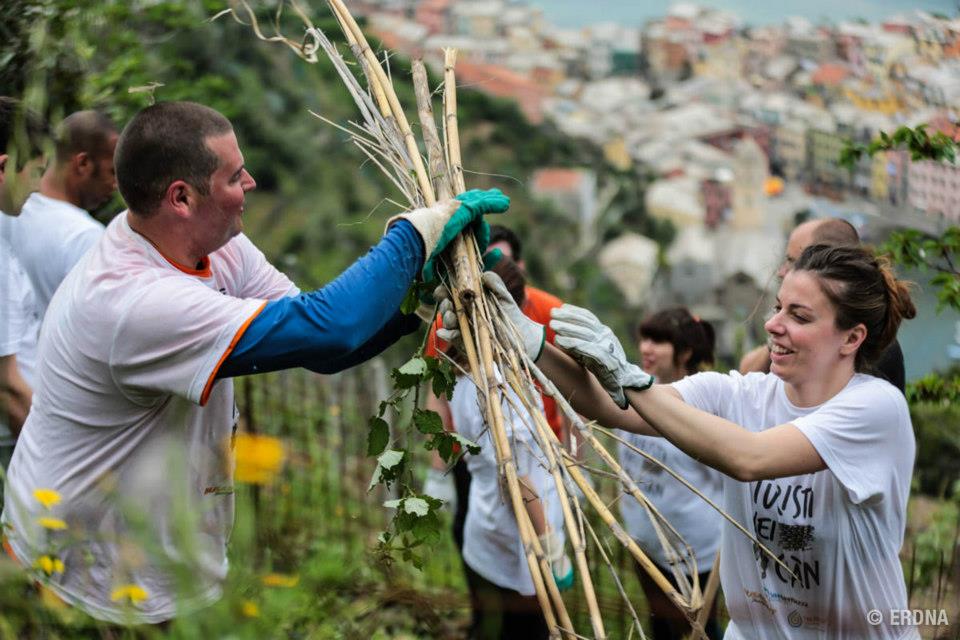
Save Vernazza, voluntourism and love for the territory
November 16, 2021
Stonewalls4life: a best practice highlighted in the Legambiente Report
December 13, 2021by Ludovica Schiaroli
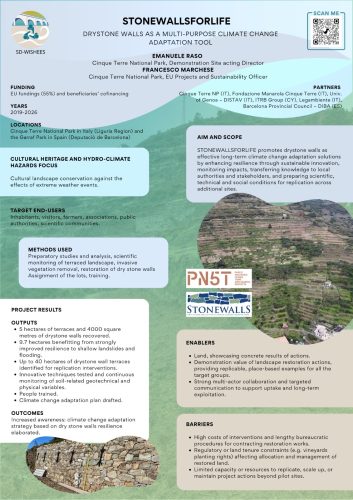
At the Parc del Garraf, the replication site of the #Stonewalls4life project, the aim is to understand the similarities and differences between two territories—Manarola in the Cinque Terre and Can Grau in Catalonia—and how adaptation to climate change can be supported through dry stone walls.
The project is presented in a video through interviews with key stakeholders involved since its inception. Andrea Vigo, researcher at the Department of Earth Sciences of the University of Genoa, explains the importance of conducting geological and geomorphological analyses in order to map the characteristics of the pilot site.
“The goal,” he explains, “is to identify, within the Parc del Garraf—specifically in Can Grau—the most suitable site for the replication of the project.”
A territory shaped by history
Santiago Llacuna, director of the Parc del Garraf, describes the history and characteristics of the area.
“This was once a harsh landscape,” he explains. “In the 17th century, many areas were reclaimed by building dry stone walls and terracing the land for vineyards. In the 19th century, with the arrival of phylloxera, vineyards disappeared and were replaced by pine forests. This increased the risk of wildfires, and in 1982 and 1994 two major fires devastated parts of the Park.”
For this reason, the Stonewalls4life project plays a crucial role: it offers tools to respond effectively to climate change.
A fragile but valuable landscape
“This is a beautiful yet fragile territory,” explains Emilio Valbuena, biologist at the Parc del Garraf, while showing the surrounding dry stone walls.
Many of these structures are abandoned or deteriorated.
“Unlike the Cinque Terre, here the main issue is not water but fire,” he says, confirming the director’s statement.
Another key difference is the use of livestock for landscape maintenance and wildfire prevention.
Scientific research and adaptation
An important scientific contribution comes from the Institut d’Estudis Penedesencs, which has been studying dry stone walls in the area.
As Adrien Gullen explains, the institute has developed a database to better understand the characteristics of the walls in Can Grau.
“What we are trying to understand is whether the original functions of dry stone walls—such as delimiting land and managing water—can be adapted to current challenges related to abandonment and erosion.”
The research focuses on identifying possible strategies to adapt these traditional structures to the impacts of climate change.
Knowledge transfer and replication
Work is progressing steadily at the replication site.
“Knowledge transfer is essential,” explains Patricia Varona Prellezo, project coordinator at the Parc del Garraf and narrator of the video. “Data, experience, and experimentation from the Cinque Terre are fundamental to developing effective solutions here.”