How to make drystone walls resistant to climate change
June 8, 2020
The therapeutic value of a Park
August 17, 2020
by Ludovica Schiaroli
Dry stone walls are part of our natural heritage, from Liguria to Sicily, from Trentino to Abruzzo. They form a landscape that tells the story of shepherds and farmers who left behind hundreds of huts, walls, and dry stone structures—today often abandoned, hidden by vegetation, and in poor condition.
Yet in recent years, many initiatives have emerged aimed at restoring and preserving these valuable structures.
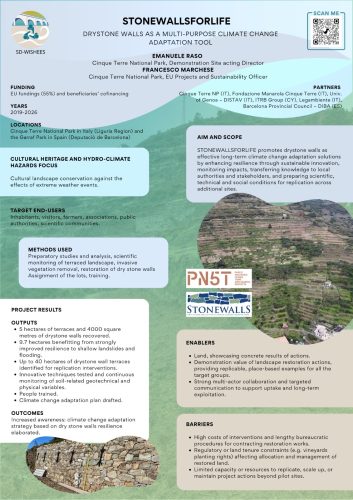
With the Stonewallsforlife project, we also aim to highlight the many people in Italy and beyond who are committed to enhancing dry stone walls—an ancient heritage that can still serve as a valuable tool in addressing climate change.
In the Majella National Park, in Abruzzo, the first training course on the construction and restoration of dry stone walls and huts was launched last year. It was organized by the Park Authority in collaboration with the Italian section of the International Terraced Landscapes Alliance (ITLA ITALIA).
“The course aimed to enhance and restore the terraced landscape of the Majella,” explains Maurizio Monaco, coordinator of the “Agro-pastoral landscape of the Park” project. “It encouraged the use of traditional, integrated, and eco-sustainable techniques, while reviving collective interest in construction practices linked to local rural traditions—now rarely used and increasingly replaced by modern building methods that are often less sustainable and of questionable aesthetic and environmental value.”
Twenty participants attended the first course, including members of agricultural cooperatives interested in deepening their knowledge of construction techniques, as well as people from outside the region.
“We received applications from all over Italy, but unfortunately we could not accommodate everyone,” Monaco adds. He also notes that the course planned for the previous spring, which was canceled due to COVID-19, will be rescheduled as soon as health conditions allow.
“Compared to last year, we have worked on a municipal plot, and now we have acquired our own land to create a permanent training site, where we can also organize environmental education activities for young people.”
Towards an Italian school of dry stone construction
Beyond training courses, the goal is to achieve formal recognition of the professional role of the “dry stone master builder.”
“We are working on this by coordinating with associations across different regions and especially with ITLA,” Monaco explains, “with the aim of creating an Italian school of dry stone construction.”
What is certain is that a new awareness is emerging across Italy. A key milestone was the recognition by UNESCO of the art of dry stone construction as Intangible Cultural Heritage of Humanity.
In December 2018, UNESCO included the dry stone construction traditions of Cyprus, Croatia, France, Greece, Italy, Slovenia, Spain, and Switzerland in the Representative List of the Intangible Cultural Heritage of Humanity, with the following motivation:
“These structures exemplify the harmonious relationship between humans and nature, while playing a vital role in preventing landslides, floods, and avalanches, as well as combating soil erosion and desertification.”